Story of the gods.

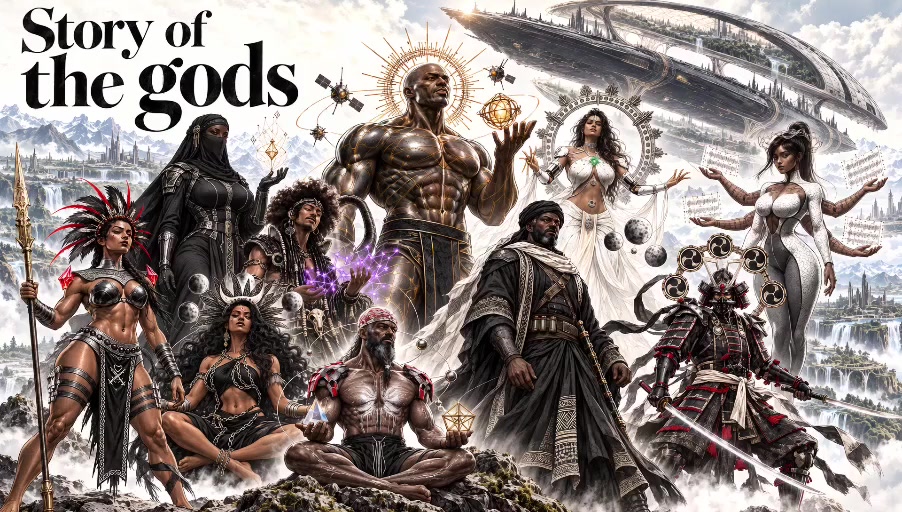
Story of the gods: the ten characters assembled beneath the Mothership.

They crossed the universe.
Humanity was still the mystery.

Enter the story
40,000 years · 10 survivors · 01 worldScroll to discover
[ 01 / The premise ]The past is ahead of us.

Humanity
has been
here before.

Before our first cities, there was a civilization that reached the stars.

Forty thousand years ago, humanity mastered the union of biology and technology. It transformed its world, then lost it to the oldest weakness of all: itself.

Ten survived. Their minds carried beyond Earth in a living vessel, they searched the cosmos for something greater. Now they return to a species approaching the same breaking point.

To us, they would seem like gods.
To themselves, they are still human.

40,000Years of civilization
10Consciousnesses preserved
01Chance to change the ending
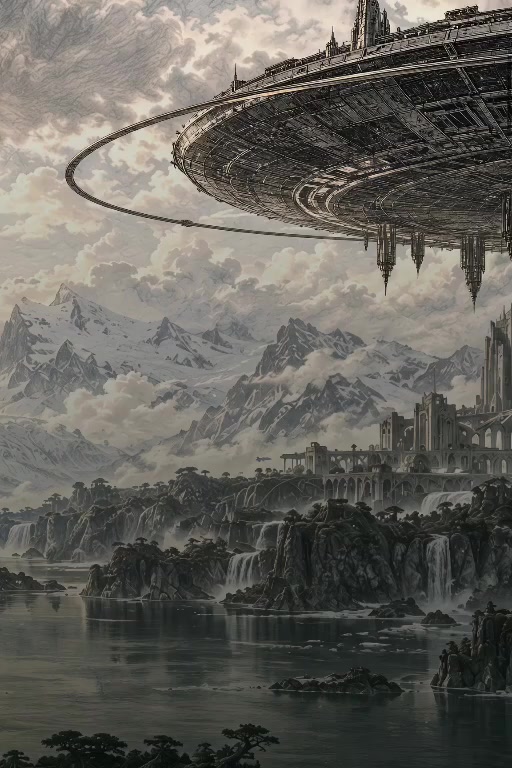
The Mothership above ancient Antarctica’s mountains, forests and monumental city.
[ 02 / Before the ice ]Earth · 40,000 years ago

A world erased from memory

Paradise.
Before the fall.

Where we see ice, they knew forests.
Where we see silence, they built a world.

Antarctica / Civilization study
[ The human condition, across the cosmos ]01 — 03

I / The fall

We conquered
everything.
Except ourselves.

A civilization beyond imagination. The same hunger for power. Progress could change their capabilities. It could not save them from greed, division, and war.
II / The transfer

The body ends.
The mind
continues.

Ten consciousnesses enter a living photon lattice aboard the Mothership, hidden in the Triangulum Galaxy. Beyond a dying world, they become the memory of a species—and the keepers of its extraordinary potential.

III / The return

Across the stars.
Back to
the beginning.

They travel the universe in search of an equal. What awaits them at home is a younger humanity repeating the same mistakes. Help it. End it. Or step aside.

Continue scrolling to move through time ↓

[ 03 / The survivors ]Human origins. Cosmic consequence.

Ten minds.
Infinite possibility.

Each carries a different answer
to the same impossible question:
what should humanity become?
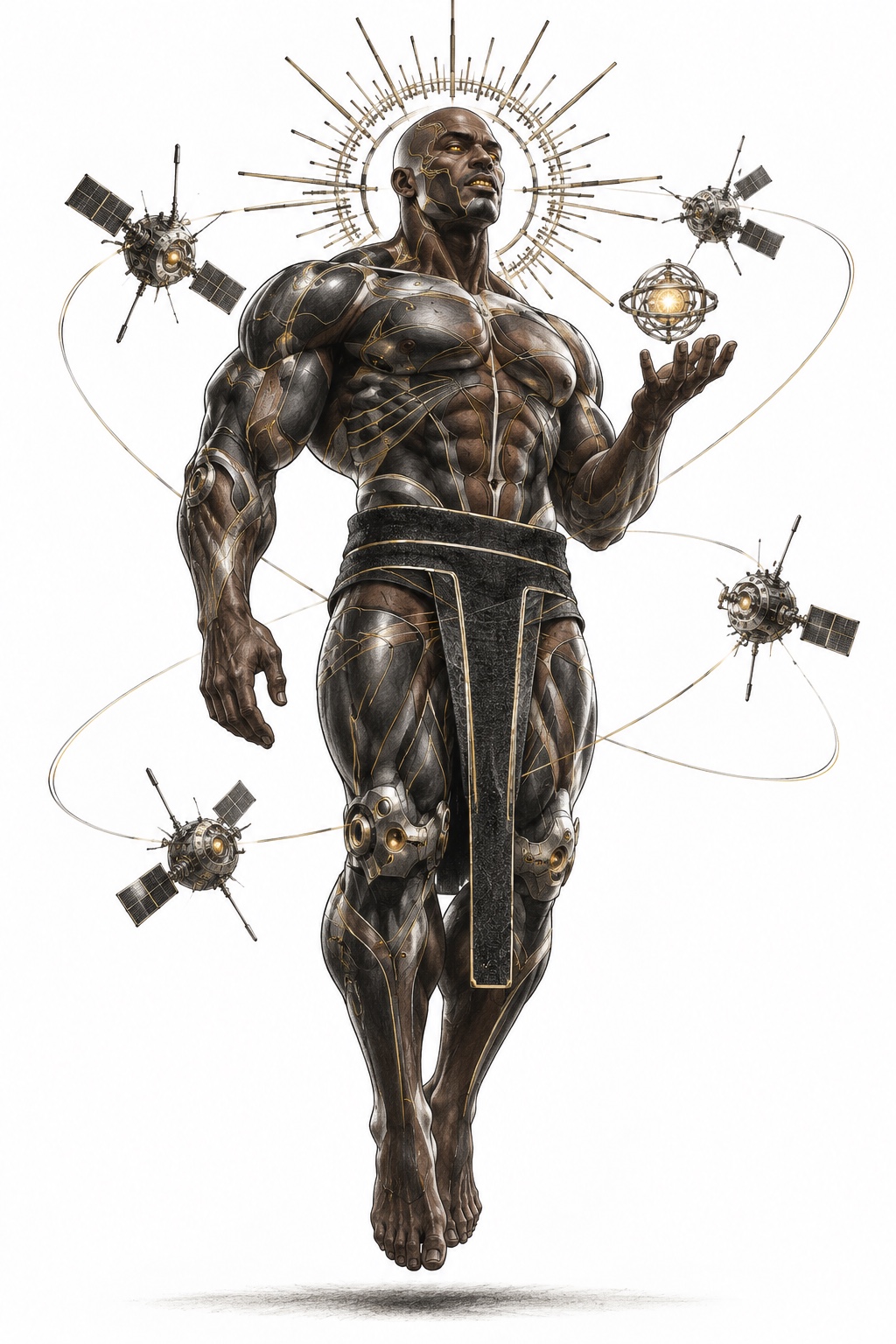
01 / 10The One Above character art
Meet the ten

Sovereignty / The sun

The One
Above

Power is a burden before it is a gift.
The human question

From the visual archive
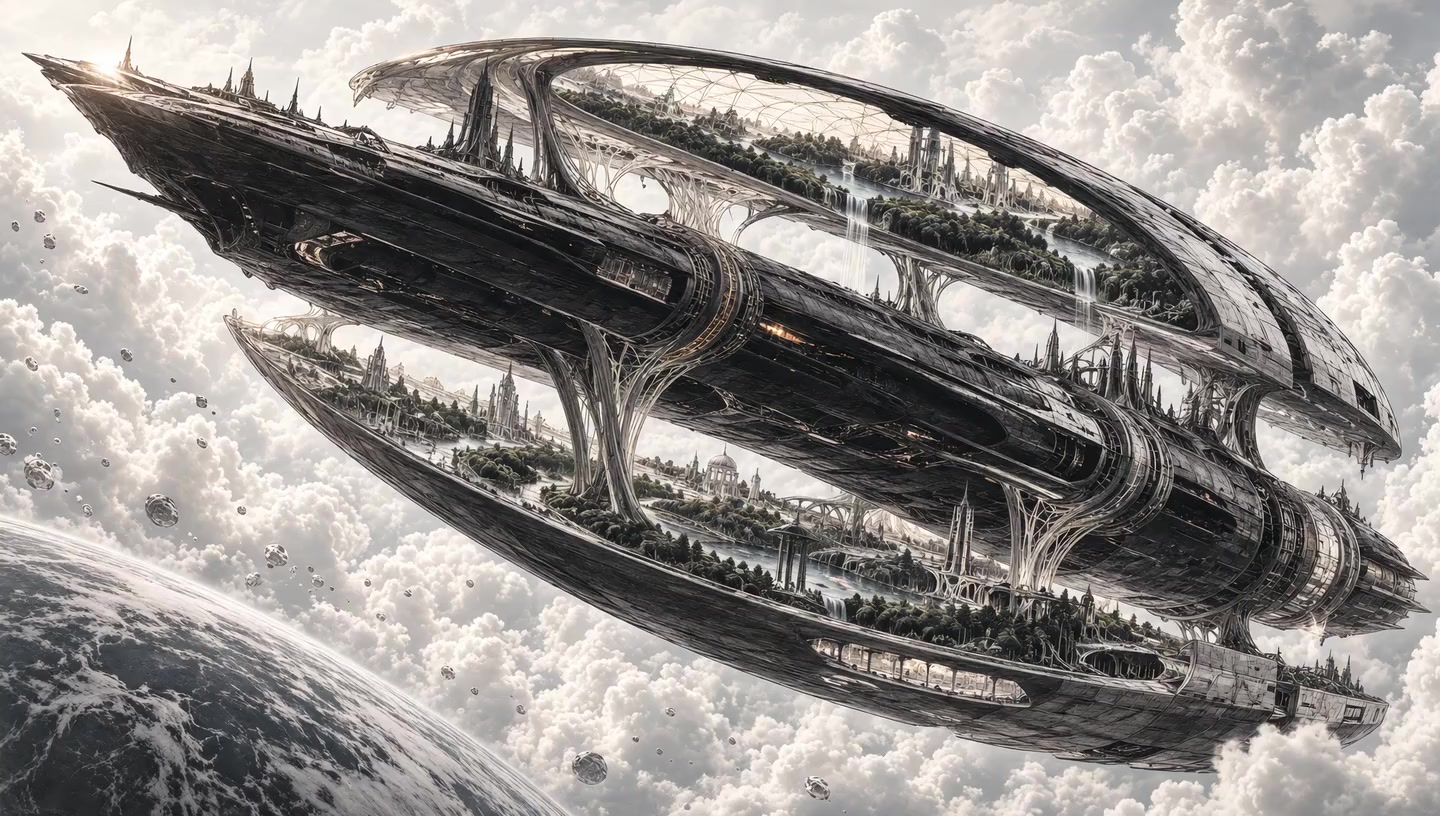
The immense Mothership emerging through clouds above a planet.
The MothershipScroll to move through the clouds
[ A different kind of science fiction ]The Mothership / Triangulum

They did not escape nature.
They learned its language.

01 / Biology

Life is the
architecture.

Their technology extends the living world. The vessel that carries them is a sanctuary for consciousness, built around a living lattice.

02 / Consciousness

The mind is
the frontier.

When the body is no longer the limit, identity becomes the question. What remains human when almost everything can change?

03 / Civilization

Progress is
not wisdom.

Greater power cannot guarantee a better world. The deepest conflict is between what humanity can do and what it chooses to become.

Solomon, a meditating sage with an exposed brain and orbiting celestial spheres, rendered in charcoal and ink.Solomon / Character study

[ 04 / A world with a signature ]

Drawn human.
Real camera.

The Sacred Seven visual canon.

A mature illustrated universe with the weight of cinema. Graphite, charcoal, ink, and visible crosshatching. Human faces with history. Monumental compositions that still leave room for silence.

The scale is cosmic. The feeling is intimate. Every impossible image begins with a recognizable human truth.

Illustrated science fictionHuman dramaCosmic scale
[ The question at the center of everything ]

If you could save
humanity from itself,
would you let it
remain free?

[ Story of the gods / Pitch treatment ]

Humanity has
been here before.

Forty thousand years ago, an extraordinary human civilization flourished on Earth.

Its people built a world where technology and biology worked as one. In the lands now buried beneath Antarctica’s ice, cities rose among forests and waterways. They looked beyond their planet and learned how to reach the stars.

But the distance between intelligence and wisdom remained. Their achievements did not free them from greed, conflict, or the desire to control one another. The civilization that had mastered its environment could not master itself.

As their world fell, ten consciousnesses were preserved in a living photon lattice aboard the Mothership, hidden in the Triangulum Galaxy. They carried the memory of their species into the universe: its knowledge, its contradictions, and the hope that its story did not have to end.

They traveled beyond familiar skies, searching for other civilizations and a greater understanding of life. The cosmos offered wonder, but no simple answer to the question of what humanity should become.

Eventually, their journey brought them back to Earth. A new human civilization had risen. Different cities. Different languages. The same capacity for beauty—and the same appetite for destruction.

To this younger humanity, the ten would appear to be gods. Yet beneath their extraordinary capabilities remained human histories, loyalties, fears, and competing beliefs about the responsible use of power.

Should they help humanity pass the Great Filter—the threshold at which civilizations destroy themselves? Wipe out a civilization they believe is beyond saving? Or step aside and let humanity choose its own fate?

Their return is not the end of humanity’s story. It is the moment humanity must confront what it could become.


The modern contact / A story thread

A college student downloads a music file. His computer malfunctions. Then a message comes through the corrupted file. What begins as a technical anomaly becomes a point of contact with an intelligence beyond his world. Later communication moves through the emerging world of Web3.

A pitch treatment adapted for this presentation. The original story and characters are by Mike Rashid King.

Download the pitch overview ↓


The human question

Early conquest design: a pale horned armored figure.

[ The art archive ]

Conquest.
An early study.

An alternate exploration of the conquest archetype, preserved as part of the universe’s visual development.

The current roster uses the Mali-inspired Al Nabarr design.